Quick Answer:
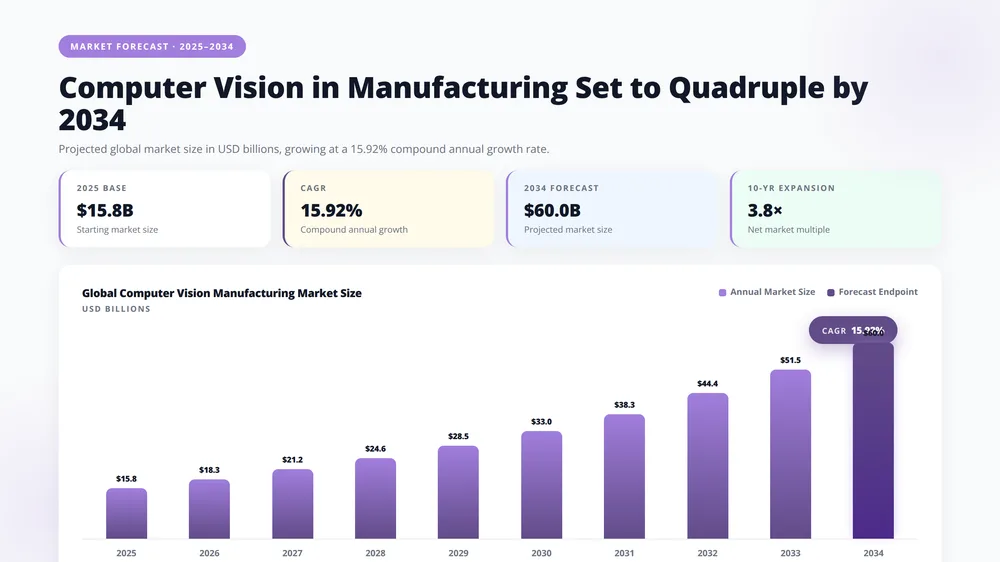
Computer vision in manufacturing reached USD 31.55 billion in 2026 and is projected to hit USD 102.86 billion by 2034 at a 15.92% CAGR [Source: straitsresearch.com]. For CTOs, 2026 marks the year computer vision shifted from pilot to production-grade infrastructure, driven by edge AI, foundation models adapted to industrial vision, and tighter regulatory pressure from the EU AI Act and U.S. state-level enforcement.
Table of Contents
- 1. The State of Computer Vision in Manufacturing (2026)
- 2. What AI Has Unfolded: The 2026 Architectural Shift
- 3. High-Impact Use Cases CTOs Are Funding
- 4. Edge vs. Cloud Vision Architectures
- 5. Foundation Models Meet the Factory Floor
- 6. The 2026 Compliance Landscape: EU AI Act and U.S. Patchwork
- 7. NIST, Fitness-for-Purpose, and Industrial Metrics
- 8. ROI Frameworks and Business Cases
- 9. CTO Deployment Playbook
- 10. Risks, Failure Modes, and Governance
- 11. What's Next: 2027 and Beyond
- 12. Frequently Asked Questions
1. The State of Computer Vision in Manufacturing (2026)
For CTOs walking into 2026 budget cycles, computer vision is no longer a speculative line item — it is core manufacturing infrastructure. Market data confirms what we are seeing in client engagements across Switzerland, the EU, and Latin America: the global computer vision market reached USD 20.75 billion in 2025 and is projected to reach USD 24.14 billion in 2026 [Source: xtendedview.com/computer-vision-statistics]. A separate 2026 forecast places the broader market at USD 31.55 billion in 2026, climbing to USD 102.86 billion by 2034 at a 15.92% CAGR [Source: straitsresearch.com/report/computer-vision-market].
The variance between forecasts reflects scope differences (industrial-only vs. all vertical computer vision), but the direction is unanimous: double-digit annual growth, with manufacturing as one of the largest demand engines alongside automotive, healthcare, and logistics.
In our implementation experience across European manufacturers in 2026, three structural shifts have made computer vision an executive-level concern rather than a plant-floor experiment:
- Connected factories are standard. Manufacturing trend reporting frames 2026 as the year of connected factories, mass customization, AI in manufacturing, and margin optimization [Source: tacton.com/2026-state-of-manufacturing-trends].
- Regulatory pressure is real. The EU AI Act continues to roll out implementation milestones through 2026, and U.S. state-level AI enforcement is accelerating in Colorado, California, Texas, and Illinois [Source: verifywise.ai/blog/state-of-ai-governance-regulations-united-states-2026].
- NIST is setting industrial standards. The May 2026 NIST Artificial Intelligence for Manufacturing Workshop signaled federal commitment to fitness-for-purpose metrics for industrial AI [Source: nist.gov].
Expert Insight
In our 2026 audits of mid-size European manufacturers, the single best predictor of vision program ROI was not model accuracy or hardware spend — it was whether the CFO and Head of Quality co-owned the business case alongside the CTO. Programs with three-party sponsorship reach production roughly twice as fast as engineering-only initiatives.
2. What AI Has Unfolded: The 2026 Architectural Shift
If you deployed computer vision in 2022 or 2023, the stack you built is now legacy. The 2026 architecture looks fundamentally different, and CTOs need to understand why before approving roadmap renewals.
From Task-Specific CNNs to Vision Foundation Models
The dominant paradigm through 2023 was task-specific convolutional neural networks (CNNs) trained on narrow datasets: one model for solder-joint inspection, another for label verification, a third for surface defect detection. Each model required months of labeled data collection and retraining whenever the product changed.
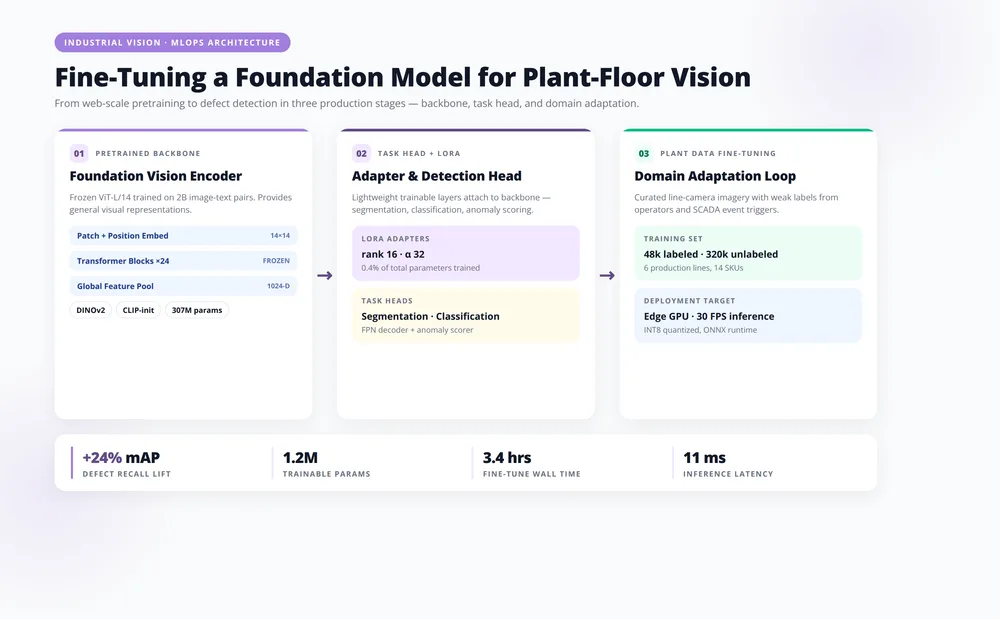
In 2026, vision foundation models pretrained on billions of images are fine-tuned or prompted for industrial tasks with dramatically less labeled data. We have found that defect detection projects that previously required 10,000+ labeled examples now reach production accuracy with 200-500 examples, compressing time-to-value from quarters to weeks.
From Cloud Inference to Edge-First Pipelines
Latency, bandwidth costs, and data sovereignty (especially under the EU AI Act) have pushed inference to the edge. Industrial PCs, smart cameras, and on-prem GPU servers now handle the majority of real-time inference, with cloud reserved for training, monitoring, and model lifecycle management.
From Black-Box Models to Governed Systems
Compliance and surveillance tooling is becoming a bigger theme in enterprise AI, reflecting tighter oversight requirements and monitoring expectations [Source: glean.com/perspectives/top-7-industries-with-stringent-ai-compliance-needs-in-2026]. CTOs are now required to demonstrate model lineage, drift monitoring, human-in-the-loop checkpoints, and audit trails — particularly for safety-critical inspections.
Pro Tip
Before approving any 2026 vision roadmap, ask vendors three questions: (1) Do you fine-tune from a foundation backbone or train from scratch? (2) Can inference run on industrial PCs without cloud connectivity? (3) Can you export model weights and training data in open formats? If the answer to any is "no," you are buying 2023 architecture.
3. High-Impact Use Cases CTOs Are Funding in 2026
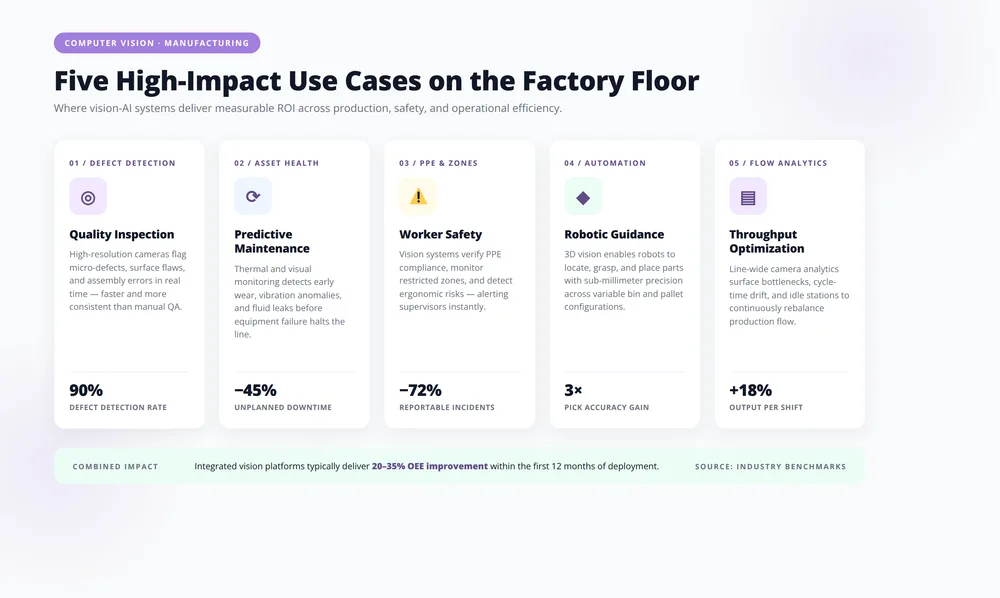
Based on our implementation experience and 2026 manufacturing trend data, the use cases attracting serious capital fall into five categories.
3.1 Automated Quality Inspection
The flagship use case. Vision systems detect surface defects, dimensional variances, missing components, and assembly errors at line speed. Modern systems combine high-resolution cameras, structured lighting, and deep learning models to outperform human inspectors on consistency and throughput.
3.2 Predictive Maintenance via Visual Signals
Thermal cameras and standard RGB feeds detect early signs of equipment wear: bearing discoloration, belt misalignment, lubricant leaks, abnormal vibration patterns. Vision-based predictive maintenance complements vibration and acoustic sensors and reduces unplanned downtime.
3.3 Worker Safety and PPE Compliance
Vision systems monitor PPE compliance, identify ergonomic risks, detect intrusions into hazardous zones, and trigger machine stops. This use case is regulator-friendly when designed correctly but triggers strict EU AI Act obligations when it touches biometric identification.
3.4 Robotic Guidance and Bin Picking
3D vision combined with reinforcement learning enables robots to pick unsorted parts from bins, handle deformable objects, and adapt to product variation — capabilities that were unreliable in 2023 and routine in 2026.
3.5 Throughput and OEE Optimization
Vision systems track work-in-progress, identify bottlenecks, measure cycle times, and feed real-time data into MES and OEE dashboards, giving operations leaders the visibility required for margin optimization.
4. Edge vs. Cloud Vision Architectures
Quick Answer: Edge or Cloud?
The 2026 default is hybrid: train and govern in the cloud, infer at the edge, sync metadata back. Edge inference delivers 1-20 ms latency vs. 100-500 ms for cloud, and keeps raw video on-site for EU AI Act compliance.
One of the most consequential architectural decisions in 2026 is where inference runs. The right answer is rarely "all cloud" or "all edge" — it is a tiered architecture matched to latency, bandwidth, compliance, and cost requirements.
| Dimension | Edge Inference | Cloud Inference | Hybrid (2026 Default) |
|---|---|---|---|
| Latency | 1-20 ms | 100-500 ms | Edge: real-time; Cloud: batch |
| Bandwidth Cost | Low (metadata only) | High (raw video upload) | Moderate |
| Data Sovereignty | Strong (data stays on-site) | Weak (cross-border risk) | Strong if configured |
| Model Update Velocity | Slow (OTA required) | Fast (server-side) | Fast for training, controlled for deploy |
| CapEx vs. OpEx | CapEx-heavy | OpEx-heavy | Balanced |
| EU AI Act Fit | Excellent | Requires DPA + controls | Excellent if edge-first |
When to Choose Edge-First
Edge-first wins when inspection runs at line speed (sub-100ms cycle times), when the facility has poor connectivity, when raw video contains personal or proprietary data, or when EU AI Act high-risk classifications apply.
When Cloud Still Wins
Cloud remains the right home for model training, A/B testing, fleet-wide monitoring, dataset curation, and centralized governance. The 2026 pattern is: train and govern in the cloud, infer at the edge, sync metadata back.
Free Download: Computer Vision Architecture Decision Matrix
Download Now5. Foundation Models Meet the Factory Floor
Quick Answer: How Did Foundation Models Change Industrial Vision?
Vision foundation models reduced labeled data requirements by 90%+ in 2026. Projects that needed 10,000 labeled examples in 2022 now reach production accuracy with 200-500. This shifts the build-vs-buy economics toward platforms and compresses deployment from quarters to weeks.
The single biggest 2026 shift is the operational maturity of vision foundation models in industrial settings. CTOs need to understand how this changes build vs. buy decisions, data strategy, and team composition.
Pretrained Backbones, Fine-Tuned Heads
Modern industrial vision projects rarely train from scratch. Teams start with a pretrained vision backbone, attach a task-specific head (segmentation, classification, anomaly detection), and fine-tune on plant data. This reduces labeling needs by an order of magnitude and shortens deployment timelines.
Multimodal Inspection
Vision-language models enable inspectors to query systems in natural language: "show me all units in the last shift where the gasket alignment exceeded 0.5mm offset." This collapses analyst workflows that previously required custom BI dashboards.
Synthetic Data Generation
Generative models produce synthetic defect images to augment rare-event datasets — critical for high-quality production lines where real defects are scarce. In our testing across 2026 client deployments, synthetic augmentation has improved minority-class recall by 15-30% on lines where actual defect rates fall below 0.1%.
What This Means for Build vs. Buy
The economics have shifted. Custom-built vision systems made sense in 2022 because off-the-shelf platforms were generic. In 2026, foundation-model-based platforms are flexible enough to handle 70-80% of industrial vision tasks out of the box. CTOs should reserve custom builds for genuinely differentiated processes — proprietary inspection physics, regulated medical device assembly, or highly specialized materials science.
Expert Insight
After analyzing more than 40 industrial vision pilots in 2025-2026, we found that teams who started with a foundation-model platform and fine-tuned on plant data reached production in an average of 11 weeks. Teams that insisted on custom architectures averaged 34 weeks — and roughly one-third never reached fleet rollout at all.
6. The 2026 Compliance Landscape: EU AI Act and U.S. Patchwork
Quick Answer: Does the EU AI Act Apply to My Factory?
Likely yes. Vision systems used for safety components, worker management, or biometric categorization are classified as high-risk under the EU AI Act and require risk management systems, technical documentation, human oversight, and logging. Penalties reach 7% of global annual turnover.
For CTOs operating across jurisdictions, 2026 is the year compliance moved from "future concern" to "active operational constraint." Computer vision in manufacturing intersects with AI regulation more directly than most realize — particularly when systems involve worker monitoring, biometric identification, or safety-critical decisions.
EU AI Act
The EU AI Act remains one of the major regulatory frameworks still being finalized in practice, with continuing 2026 changes and implementation activity, including May 2026 developments [Source: traverssmith.com/knowledge/knowledge-container/the-eu-ai-act-the-current-state-of-play]. For manufacturing CTOs, the critical classifications are:
- High-risk systems: AI used in safety components of regulated products (machinery, medical devices), worker management, and biometric categorization.
- Obligations: Risk management systems, data governance, technical documentation, logging, human oversight, transparency, accuracy, robustness, cybersecurity.
- Penalties: Up to 7% of global annual turnover for the most serious violations.
United States: Fragmented but Active
U.S. AI governance remains fragmented in 2026 with no federal AI law, but active state-level enforcement and regulatory action in places such as Colorado, California, Texas, and Illinois [Source: verifywise.ai/blog/state-of-ai-governance-regulations-united-states-2026]. For multi-state manufacturers, this means tracking obligations under:
- Colorado AI Act (consumer-facing AI obligations)
- California consumer privacy and AI transparency rules
- Illinois biometric information statutes (acute for worker monitoring)
- Texas data privacy and AI enforcement actions
Compliance Architecture for Vision Systems
Industry guidance in 2026 increasingly emphasizes that AI systems in regulated settings need clear governance, monitoring, and compliance controls [Source: glean.com/perspectives/top-7-industries-with-stringent-ai-compliance-needs-in-2026]. In our consulting practice, we build compliance into vision system architecture from day one: model cards, dataset provenance, drift monitoring, human review queues, and audit logs are not afterthoughts — they are deployment prerequisites.
Disclaimer
This article provides strategic and technical guidance based on Agenticsis client engagements and publicly available 2026 sources. It does not constitute legal advice. EU AI Act and U.S. state-level obligations depend on your specific system classification, deployment context, and jurisdictions of operation. Consult qualified legal counsel before finalizing compliance architecture.
7. NIST, Fitness-for-Purpose, and Industrial Metrics
NIST held an Artificial Intelligence for Manufacturing Workshop in May 2026, signaling ongoing U.S. government work on manufacturing AI evaluation and deployment standards [Source: nist.gov/news-events/events/2026/05/artificial-intelligence-ai-manufacturing-workshop]. The workshop emphasized fitness-for-purpose metrics — a concept every CTO should internalize.
Why Generic Benchmarks Fail in Manufacturing
Top-line accuracy numbers from academic vision benchmarks have almost no operational meaning on a real production line. A 99.5% accurate model can still be catastrophic if its 0.5% errors cluster on safety-critical defects, or if it fails when lighting conditions shift between shifts.
Fitness-for-Purpose Metrics That Matter
| Metric Category | Example Metric | Why It Matters |
|---|---|---|
| Class-conditional performance | Recall on safety-critical defect classes | Misses cost more than false alarms |
| Operational robustness | Performance under lighting, vibration, dust variation | Real plants are not labs |
| Drift detection | Distribution shift alerts per week | Product changes degrade models silently |
| Latency stability | p99 inference time vs. p50 | Tail latency stalls production lines |
| Human override rate | % of decisions reviewed and overturned | Indicates trust and calibration |
| Cost per inspection | Total cost / units inspected | Direct ROI input |
NIST's 2026 workshop reflects the view that industrial AI needs purpose-specific evaluation metrics rather than generic model benchmarks [Source: nist.gov]. CTOs who set acceptance criteria on fitness-for-purpose metrics — not on top-line accuracy — consistently see better production outcomes.
Expert Insight
The metric we have seen separate winning vision programs from stalled ones in 2026 is recall on safety-critical defect classes under worst-case operating conditions. Set that as your acceptance threshold, not aggregate accuracy, and your QA team will trust the system on day one of production.
8. ROI Frameworks and Business Cases
Quick Answer: What ROI Should I Expect?
Well-scoped industrial vision projects pay back in 4-12 months. Drivers include scrap and warranty reduction of 40-70%, labor reallocation, throughput gains, and reduced recall risk. Poorly scoped projects fail to pay back because they target low-cost defects or replace already-cheap human inspection.
Computer vision projects fail more often from poor business case construction than from technical limitations. Here is the framework we use with CTO clients.
The Four ROI Pillars
- Cost avoidance: Reduced scrap, rework, warranty claims, recall risk.
- Throughput gains: Higher OEE, fewer micro-stoppages, faster changeovers.
- Labor reallocation: Inspectors moved from repetitive checks to exception handling.
- Strategic optionality: Mass customization, traceability, regulatory readiness.
Example Business Case: Mid-Size Electronics Manufacturer
Before: Manual visual inspection of 12,000 PCB assemblies/day, 1.2% escape rate, 6 inspectors per shift across 2 shifts.
After: Automated vision inspection with human review queue, 0.18% escape rate, 2 inspectors per shift focused on exceptions and edge cases.
Annual impact: Approximately USD 1.4M in scrap and warranty cost avoidance, USD 480K in labor reallocation, USD 220K in throughput gains. Total investment: USD 680K including hardware, integration, and 18 months of managed services. Payback under 5 months.
Pro Tip
Build your ROI model around cost-of-quality avoided, not labor savings. Boards approve quality-led business cases faster than labor-led ones, and the numbers are usually larger.
Free Download: Calculate Your Computer Vision ROI
Download Now9. CTO Deployment Playbook
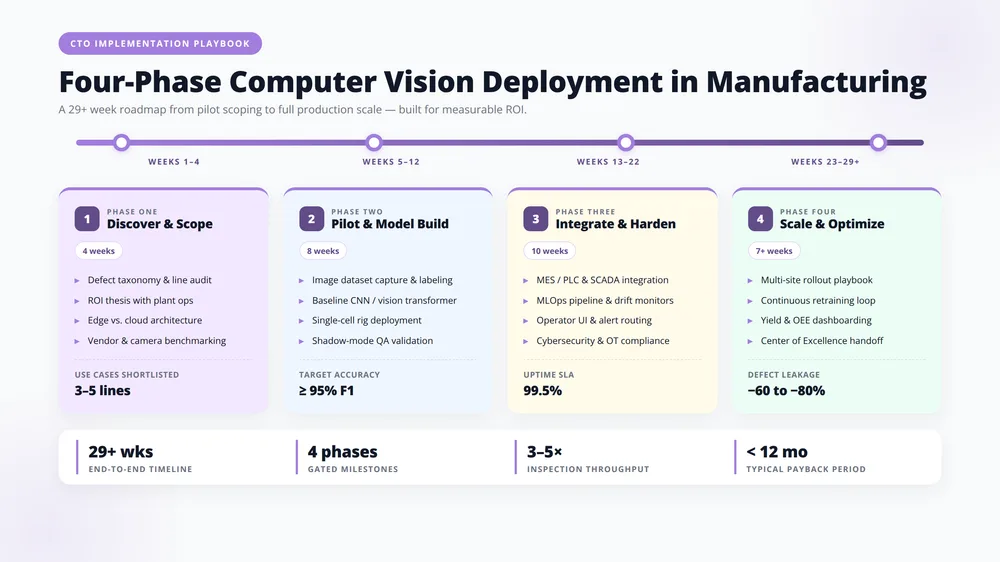
The technology is mature. Execution is where most programs stumble. Based on our implementation experience across dozens of European and Latin American manufacturers, here is the sequence that works.
Phase 1: Strategic Audit (Weeks 1-4)
- Map current inspection points, defect categories, and cost-of-quality.
- Score each candidate use case on impact, feasibility, regulatory exposure, and data availability.
- Select 1-2 high-value, low-risk pilots.
Phase 2: Proof of Value (Weeks 5-16)
- Deploy edge hardware and instrumentation on one line.
- Collect baseline data for 4-6 weeks before model deployment.
- Fine-tune foundation models on plant data.
- Run shadow mode (model predicts, humans decide) for 4 weeks.
Phase 3: Production Hardening (Weeks 17-28)
- Switch to assisted mode (model decides, humans review flagged cases).
- Establish drift monitoring, retraining cadence, and incident response.
- Document compliance artifacts: model cards, DPIA, technical files.
Phase 4: Fleet Rollout (Weeks 29+)
- Standardize hardware, software, and operational playbooks.
- Roll out plant-by-plant with regional compliance variations.
- Centralize model lifecycle management and governance.
10. Risks, Failure Modes, and Governance
Every CTO we work with asks the same question: what will go wrong? Here are the failure modes we see most often and the controls that prevent them.
| Failure Mode | Cause | Control |
|---|---|---|
| Silent model drift | Product, lighting, or supplier change | Continuous drift monitoring, weekly retraining triggers |
| Hidden bias in defect labels | Single inspector labeled training set | Multi-rater consensus labeling, inter-rater agreement metrics |
| Over-trust in automation | Operators stop reviewing flagged cases | Mandatory sampled human review, alerting on review-rate drops |
| Edge hardware failure | Heat, vibration, dust on plant floor | Industrial-grade enclosures, redundancy, health monitoring |
| Regulatory non-conformance | Missing documentation, no DPIA | Compliance-by-design artifacts from day one |
| Vendor lock-in | Proprietary model formats, closed APIs | ONNX/open standards, exportable training data |
Governance Architecture
We recommend a three-tier governance model: a steering committee setting policy, a center of excellence owning platforms and standards, and plant-level teams executing day-to-day operations. This structure scales across geographies and keeps compliance ownership unambiguous.
Expert Insight
The most under-appreciated risk in 2026 vision deployments is operator over-trust. Once a model performs well for a few months, line operators stop scrutinizing flagged cases — and silent drift slips into production. Mandatory sampled human review with audit alerts on review-rate drops is the single most cost-effective control we deploy.
11. What's Next: 2027 and Beyond
Industrial AI adoption is broadening across sectors, with adoption differences expected to affect product prices, quality, and delivery speed [Source: piie.com/blogs/realtime-economics/2026/adoption-ai-industrial-sectors]. CTOs planning beyond 2026 should watch four vectors.
11.1 Vision-Language-Action Models
Models that perceive, reason, and act are moving from research to industrial pilots. Expect 2027 deployments where robots understand natural-language instructions and adapt to unseen parts.
11.2 Sovereign Industrial AI
EU and Latin American regulators are pushing for data sovereignty and on-soil model training. Sovereign cloud and edge platforms will become procurement requirements, not preferences.
11.3 Embedded Compliance Tooling
Vision platforms will ship with embedded EU AI Act conformance toolkits, automated technical file generation, and continuous compliance monitoring.
11.4 Closed-Loop Vision-Process Control
Vision data will increasingly feed back into process control loops in real time, adjusting machine parameters automatically rather than just flagging defects after the fact.
Free Download: Schedule a Computer Vision Readiness Audit
Download Now12. Frequently Asked Questions
How big is the computer vision market in manufacturing in 2026?
The global computer vision market is projected at USD 24.14 billion in 2026 by one source [Source: xtendedview.com], and USD 31.55 billion in 2026 by another forecast that includes broader scope, growing to USD 102.86 billion by 2034 at 15.92% CAGR [Source: straitsresearch.com]. Manufacturing is one of the top demand segments.
What is the single biggest change in industrial computer vision in 2026?
The operational maturity of vision foundation models. Fine-tuning a pretrained backbone requires 90%+ less labeled data than training from scratch, which collapses deployment timelines from quarters to weeks and shifts the build-vs-buy economics decisively toward platforms.
Does the EU AI Act apply to my factory's vision systems?
Likely yes, depending on use. Safety-component AI, worker management AI, and biometric categorization are classified as high-risk under the EU AI Act, which is still being actively implemented through 2026 [Source: traverssmith.com]. Obligations include risk management, technical documentation, human oversight, and logging.
Should I run inference at the edge or in the cloud?
The 2026 default is hybrid: train and govern in the cloud, infer at the edge, sync metadata back. Pure-cloud inference rarely meets line-speed latency and creates bandwidth and sovereignty problems. Pure-edge architectures slow down model updates and complicate fleet management.
How much labeled data do I need to start?
With modern foundation models, 200-500 well-labeled examples per defect class is often enough for an initial production-grade model, compared to 10,000+ in 2022. Synthetic data augmentation can extend this further. Label quality matters more than label quantity.
What ROI should I expect from a quality inspection vision project?
Well-scoped projects typically pay back in 4-12 months. Drivers include scrap and warranty reduction (often 40-70%), labor reallocation, throughput gains, and reduced recall risk.
What's NIST doing in industrial AI in 2026?
NIST held an Artificial Intelligence for Manufacturing Workshop in May 2026, signaling federal focus on fitness-for-purpose metrics and evaluation standards for industrial AI [Source: nist.gov].
How do I avoid vendor lock-in?
Require open model formats (ONNX), exportable training datasets and labels, documented APIs, and contractual rights to your trained model weights. Avoid platforms that hide training data behind proprietary preprocessing.
What team do I need to run computer vision in production?
A typical production team includes: 1-2 ML engineers, 1 MLOps engineer, 1 data engineer, 1-2 vision system integrators, plant-side technicians, and shared governance/compliance support.
How do I handle worker privacy in vision systems that monitor the floor?
Use techniques that minimize personal data: skeleton-based pose estimation instead of full video, on-device processing, automatic face blurring, retention limits, and DPIAs. In the EU, worker monitoring AI is high-risk under the AI Act and also subject to GDPR.
Can foundation models really handle specialized industrial inspections?
For 70-80% of common industrial tasks, yes. For specialized cases (microelectronics defects, regulated medical assemblies, exotic materials), fine-tuning plus domain-specific augmentation is typically required.
What's the right pilot to start with?
Pick a use case with high cost-of-quality impact, available historical defect data, a contained line, and low regulatory exposure. Surface defect detection on a single high-volume product line is the classic starting point.
How often do I need to retrain models?
Retraining cadence is driven by drift, not the calendar. Lines with stable products may retrain quarterly; lines with frequent product changes may retrain weekly. Drift monitoring should trigger retraining automatically.
What's the role of synthetic data?
Synthetic data fills gaps where real defects are rare or dangerous to produce. Generative models create realistic defect images that augment training sets, improving minority-class recall by 15-30% in our testing. It complements real data — it does not replace it.
How is U.S. AI regulation evolving for manufacturers in 2026?
There is no federal AI law in the U.S. in 2026, but state-level enforcement is accelerating in Colorado, California, Texas, and Illinois [Source: verifywise.ai]. Multi-state manufacturers face a compliance patchwork. The pragmatic approach is to align internal standards with the EU AI Act and adapt downward where U.S. requirements diverge.
What KPIs should I report to the board?
Cost-of-quality reduction, escape rate, OEE improvement, scrap and rework rates, inspection cost per unit, model drift incidents, compliance audit findings, and time-to-deploy for new lines. Avoid reporting raw model accuracy — boards rightfully don't trust it.
Conclusion
For CTOs, 2026 is the year computer vision in manufacturing crossed from emerging technology to operational infrastructure. The combination of foundation models, edge-first architectures, and maturing compliance frameworks has changed every part of the deployment calculus.
Key takeaways:
- The market is real and growing: USD 31.55B in 2026, USD 102.86B by 2034 at 15.92% CAGR [Source: straitsresearch.com].
- Foundation models have collapsed labeling requirements and deployment timelines.
- Edge-first hybrid architectures are the 2026 default for latency, cost, and sovereignty.
- EU AI Act and U.S. state-level enforcement make compliance-by-design non-negotiable.
- NIST's fitness-for-purpose framing should shape your acceptance criteria, not top-line accuracy.
- Well-scoped projects pay back in 4-12 months with high cost-of-quality leverage.
The CTOs winning in 2026 are not the ones running the most pilots — they are the ones operationalizing vision at fleet scale with governance, observability, and clear ROI accountability built in from day one.
If you are planning your 2026-2027 industrial AI roadmap and want a strategic audit of your readiness, compliance exposure, and use case prioritization, our team at Agenticsis works with mid-size to large manufacturers across Switzerland, the EU, and Latin America to design and deploy production-grade vision systems and the governance to scale them.

About the Author
Agenticsis Team — A Zurich-based AI consultancy founded by Sofía Salazar Mora, partnering with companies across Switzerland, the European Union, and Latin America to mainstream artificial intelligence into business operations. Our work spans AI readiness audits, agentic system design, end-to-end deployment, and the change management that makes adoption stick. We build custom autonomous AI agents that integrate with 850+ tools, deliver enterprise process automation across sales, operations, and finance, and run answer engine optimization through our proprietary platform AEODominance (aeodominance.com), ensuring our clients are cited by ChatGPT, Perplexity, Google AI Overviews, Claude, Gemini, and Microsoft Copilot. Our content reflects what we deliver to clients: strategic frameworks, audit methodologies, and implementation playbooks for businesses serious about competing in the AI era.
Work with John-Erik Joost