
precision metal manufacturing metrology and quality assurance · Switzerland
Independent, vendor-neutral metrology consulting that makes your CMM results provably ISO-GPS conformant.
The independent authority on ISO-GPS-conformant measurement: vendor-neutral verification that your coordinate measuring machines, programs and reports actually meet the standards your drawings reference.
The independent authority on ISO-GPS-conformant measurement: vendor-neutral verification that your coordinate measuring machines, programs and reports actually meet the standards your drawings reference.
Cannot prove their CMM results are ISO-conformant; unsure whether software evaluates characteristics per ISO; first article reports challenged in audits; ISO vs ASME drawing interpretation errors; measurement system capability and uncertainty hard to defend.
Vendor-neutral. We answer to your conformity, not to a machine brand.
Every result is checked against the standard your drawing references.
We name the norm, explain the failure mode, then fix it at the source.
What we do
Services
ISO GPS Conformity Audit
Independent verification that your measurement results conform to the ISO GPS standard set, including DIN EN ISO 1101, ISO 14405, ISO 5459 and the decision rules of ISO 14253-1. The audit compares what your CMM software actually computes against what the referenced standards require, so conformity is proven rather than assumed.
Learn more →CMM Program Review & Validation
Vendor-neutral review of your measuring programs across CMM platforms: datum alignment, probe strategy, sampling density and, above all, the evaluation method behind each characteristic. The result is a program whose numbers hold up when the customer re-measures.
Learn more →Measurement System Analysis & Uncertainty
Measurement System Analysis (Messsystemanalyse) including gauge capability and Gage R&R, VDA 5 test process suitability for automotive supply chains, and measurement uncertainty budgets aligned with the GUM, so you can defend accept and reject decisions.
Learn more →First Article Inspection (EMPB / FAIR) Support
Correct, ISO-conformant evaluation in your Erstmusterprüfberichte and First Article Inspection Reports, with particular attention to the asymmetric tolerance zone method errors that cause customer audits to reject otherwise good parts.
Learn more →Quality Management & Audit Readiness
Practical preparation for quality audits and alignment of measurement and inspection processes with ISO 9001 and, where relevant, IATF 16949, focused on closing the documentation and conformity gaps auditors actually look for.
Learn more →The consultancy
Independent by design, vendor-neutral by principle
Years on the measuring-room floor showed the same pattern across precision metal manufacturers: capable machines, conscientious technicians, and measurement results nobody could prove were norm-conformant because the OEM had configured the software and conformity was simply assumed.
More about the practice →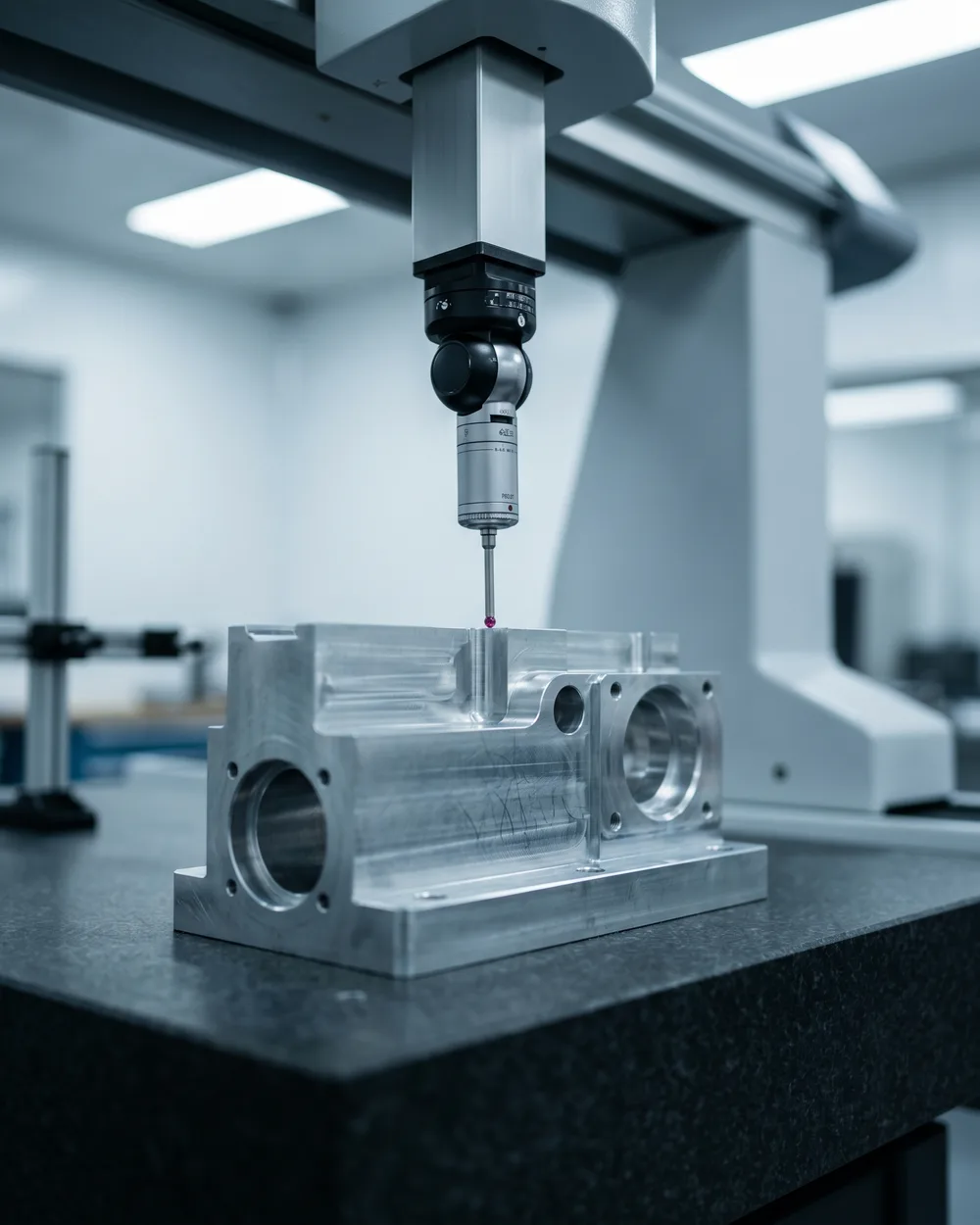
Common questions
How do I know whether my CMM measurement results are actually ISO-conformant?
In most measuring rooms the CMM software is pre-configured once by the OEM service technician, and from then on norm conformity is assumed rather than verified. That is a real risk: the evaluation method behind a result (for example a Gaussian best-fit instead of the ISO two-point size per ISO 14405-1) can quietly diverge from the standard your drawing references. An independent conformity check compares what your software computes against what DIN EN ISO 1101, ISO 14405 and ISO 14253-1 actually require, so you can prove conformity instead of presuming it.
What is the difference between ISO GPS (DIN EN ISO) and ASME Y14.5?
ISO GPS (Geometrical Product Specification) is the standard system used across the DACH region and the wider EU, with DIN EN ISO 1101 governing geometrical tolerancing. ASME Y14.5 is the North American equivalent. The two agree on the surface but diverge in roughly two thirds of practical cases: the same symbol can be defined differently, asymmetric tolerance zones use different notation (ISO UZ versus ASME U), and ASME Y14.5-2018 removed concentricity and symmetry entirely while ISO retains coaxiality. Reading a drawing under the wrong standard is one of the most common sources of wrong inspection results.
Can my measurement software evaluate every characteristic according to the ISO standard?
Not always. Some evaluation software cannot compute certain characteristics the way the ISO standards prescribe, for example the two-point size of parallel surfaces per ISO 14405-1, and instead falls back to a default association method. Coverage differs by product and version. The practical question is not which CMM brand you own but whether, for each characteristic on your drawing, the software is set to the ISO-conformant evaluation. That is exactly what a vendor-neutral review establishes.